|
Field Stations
|
High-Precision GPS Stations
Different displacement monitoring applications require different technical
approaches. This is why we have designed several GPS field stations over the
past decade: to offer greater flexibility in the implementation of GPS monitoring
networks.
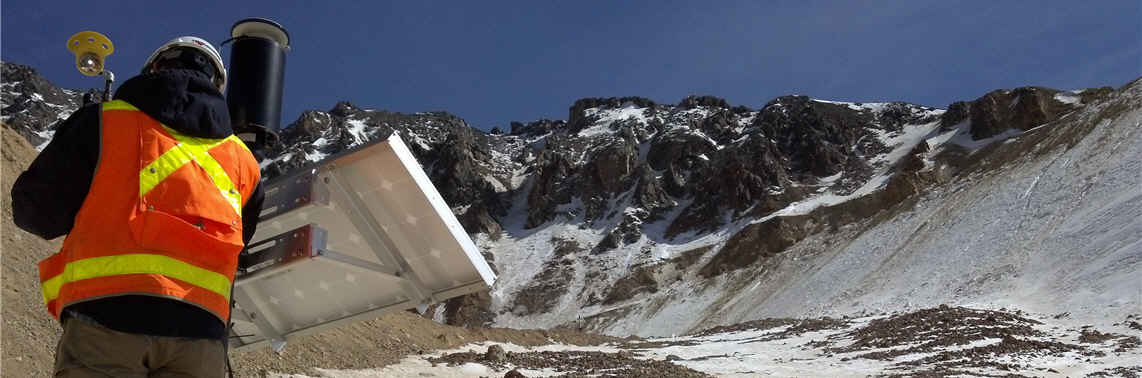
We start with three standard field station models:
- CAN-GPS - Single-point
integration of GPS and wireless in a lightweight,
hardened, portable enclosure (modular; independent power supply)
- MultiPoint GPS - Multiple GPS
integrated through a single wireless
device, enclosure and power supply; equipped for multiple, extended cable runs;
power supply specified to meet system consumption and site conditions.
- Infrastructure GPS - GPS and antenna
integrated with application and
site-specific communications device (wired or wireless); designed to leverage
existing power and communications; lowest cost; often used for network
reference stations.
These models can be deployed as-is for immediate, network
service or modified for specific network application and environment.
Standard Components
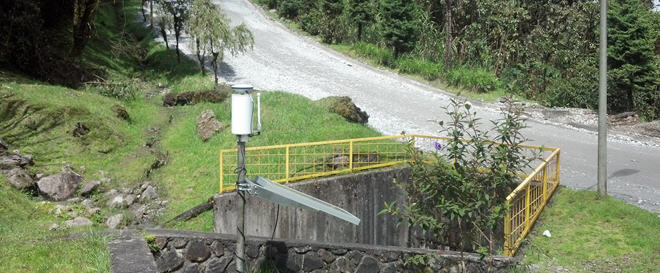
Although we offer multiple independent designs, each field station integrates three core components
needed to deliver a fully operational field station:
- Single and dual frequency carrier phase
positioning provided by Novatel's line of high-precision GPS and
GPS/GLONASS receivers and antennae, including Novatel's GPS-701-GG (or 702-GG) antenna
with patented Pinwheel™ multipath mitigation technology.
- Wireless communications enabled by either:
- 2.4 GHz 802.11b/g (Wi-Fi)
- 902-928 MHz spread spectrum
- Solar power with battery backup including fully-automatic
solid-state charge controllers and maintenance-free,
sealed, deep-cycle batteries.
Modify to Suit
Beyond these base considerations, stations can be further modified
to support:
- High rate kinematic or static GPS positioning - Dual or single frequency
GPS recievers and antennae; increased wireless network bandwidth
- Communications options - Existing infrastructure; wireless or wired; Ethernet
or serial; antenna transmission line (cable length/loss and antenna style/gain)
- Power supply - Solar or AC supply; tie-in to existing power infrastructure;
battery and recharge capacity; charger and controllers
- Antenna transmission line - Cable length (cable runs verified to 200 m);
lightning protection
- Enclosure style
Whatever the application, Orion can provide a station to meet your monitoring needs.
Notes:
- Solar systems are shipped with side-of-pole solar panel and enclosure
mounting hardware. Solar systems can be provided in UL and non-UL rated designs.
- Lightning/surge protection is typically included with MultiPoint-GPS
but not with CAN-GPS systems. Extended MultiPoint antenna cables may act as transmission lines
for induced surges. CAN-GPS antennae are typically co-located and sources would be proximal to all
equipment, likely leading to damage regardless of surge protection.
|